




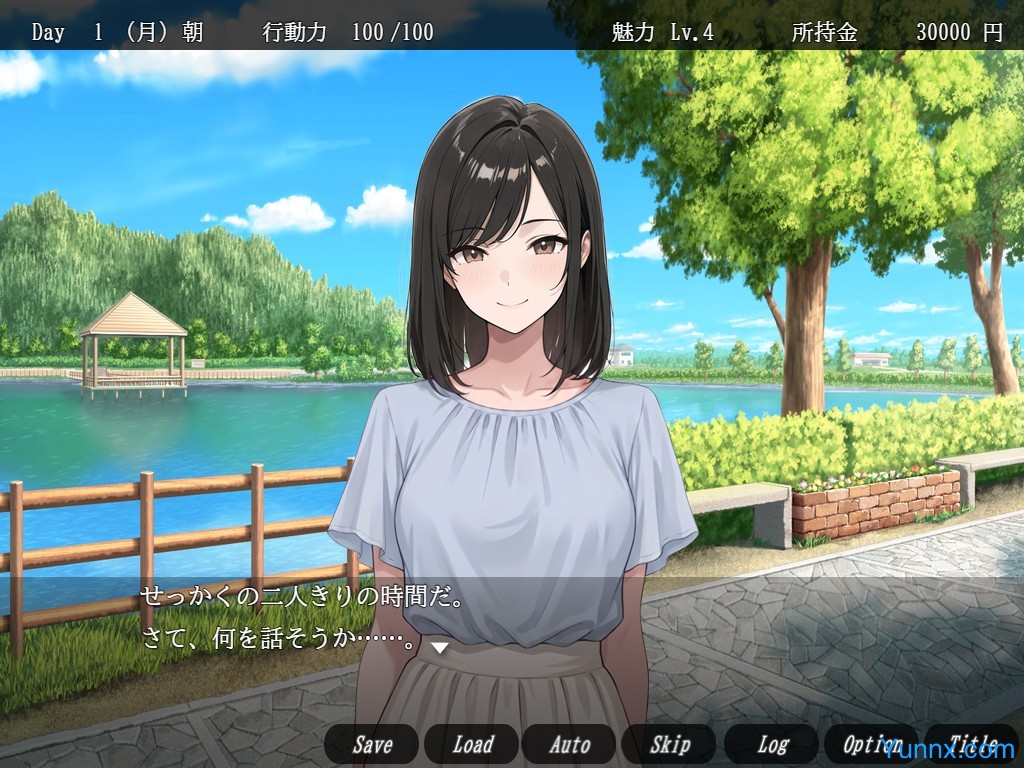
A part-time supermarket worker, worn down by rejection and his own sense of worthlessness, helps a new neighbor set up the store app. Akise Shiori looks like the perfect housewife — composed, serious, ordinary. Then he sees the icon on her phone. What follows is a slow collision between a woman split in two and a man who can reach her from both sides of the screen.
The moment a glance becomes a decision
1. Nothing dramatic happens at first. A customer asks for help. He taps through a setup screen. His thumb stops because one icon does not belong in the life she appears to be living, and the silence after that is where the story actually starts.
2. Curiosity here is not noble. It arrives mixed with resentment and the kind of interest that makes you ashamed of yourself while you feed it. He does not report what he saw. He does not forget it either. He holds it, and holding it changes how he looks at her the next time she walks in.
3. The game understands that most ruin begins with something small and private. Not a confession, not a confrontation — just a piece of knowledge kept too long, until keeping it becomes a kind of participation.
Shiori: the woman who keeps two ledgers
1. On the surface she is exactly what the neighborhood expects. Polite greetings, exact change, a basket arranged with care. She has built a life that photographs well and requires her to be nobody in particular, which is its own kind of exhaustion.
2. The app is not a mistake or a hack. It is a door she opened on purpose, and the fact that she cannot explain why — even to herself — is what makes her dangerous to everyone around her, including the man who now knows.
3. Her conflict is not between right and wrong but between two versions of herself that both feel true. Morality pulls one way, hunger the other, and the space between them is where both men find their opening. Which one wins depends less on what they do than on what she finally allows.
Two men, one of whom only exists on a screen
1. The first is the actual person: a tired employee with bad shoes and a real name, who reaches her with plain kindness and the unglamorous honesty of someone who has nothing left to sell. That sincerity is more disarming than any line, because she has no defense against being treated like a person instead of a role.
2. The second is a persona crafted for her screen — a voice tuned to exactly what she came looking for, patient, flattering, and never inconvenient. He can be whoever the app tells her she wants, because he does not have to live with her afterward.
3. The trap works because it is sweet, not because it is clever. Every message lands at the moment she is weakest, every promise fits the shape of the life she cannot admit she misses. By the time she notices the difference between the man and the mask, she has already told them both things she cannot take back.