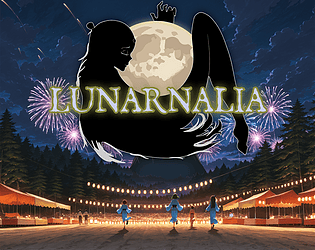

Crater Hallow is the kind of mountain town where everyone knows your grandmother's confession schedule and the choir director's glare can sour milk. Deeply devout, conventionally sleepy, the kind of place where nothing should happen — until the summer solstice rolls around and the whole valley wakes up for Lunarnalia, the festival honoring moon goddess Luna and the bounty she "provides." You're Gabriel. You grew up here. You know the hymns, the rituals, the way the townsfolk get that glassy, faraway look in their eyes when the first night of the festival hits. This year though… something's off. The church of Lunarology is running deeper than usual. Your friends are acting strange. Your family won't answer direct questions. And somewhere between the bonfires, the offerings, and the way the moonlight hits the chapel steps — your sanity and your virginity are both on the line.
Crater Hallow — God-Fearing, Moon-Worshipping, and None of Your Business
1. The town presents itself as wholesome. White clapboard houses, flower boxes, a general store that still runs a tab. The kind of place where strangers get sized up in three seconds and either waved into the diner or quietly discouraged from staying. Religion here isn't a Sunday thing — it's the mortar holding the bricks together. The Church of Lunarology doesn't compete with civic life. It is civic life. Mayor, deacon, PTA treasurer — same rotating five people, all Luna-devoted, all watching.
2. Lunarnalia is the annual hinge point. Three nights where the town collectively suspends its "proper" face and gives itself over to celebration, libation, and rites that the tourist pamphlets describe very carefully as "traditional harvest observances." Translation: the whole town gets weird. Bonfires on the ridge. Processions through the square. Offerings left on porches no one claims to own. People smile wider. Touch your arm longer when they pass you on the street. And the moon — this fat silver coin that hangs so low it feels like it's inspecting the rooftops — never quite looks like reflected sunlight.
3. Gabriel's the outlier by default. Not because he doesn't believe (he does, sort of, in the way you believe in gravity because it keeps dropping things on you), but because he's always been the one standing slightly outside the circle with a folding chair, watching. Sensible. Grounded. The kid who helped his mom arrange flower offerings and counted the collection plate because someone had to. That grounded-ness is exactly what makes him dangerous to whatever's actually running beneath the festival — and exactly what makes him a target.
The Church of Lunarology — Bounty Means Something Specific Here
1. The theology sounds benign on paper. Luna blesses the harvest, Luna guards the dark hours, Luna's grace is "bounty" measured in crops, children, health, prosperity. Lovely. Poetic. Hang a wreath on it. But the closer Gabriel looks — the more he questions why the offering amounts doubled this year, or why his childhood friend came back from acolyte training looking like she hasn't slept since March — the clearer it gets that bounty isn't just a metaphor the church uses for wheat and rain.
2. The church hierarchy operates with that smooth, small-town authority where no one ever raises their voice and everything is "encouraged" so firmly it might as well be law. The high deaconess smiles when she says things. The choir hums while the collection plates rattle. And the things Gabriel catches in peripheral vision during midnight services — the way shadows on the altar don't match the candlesticks, the way certain congregants' pupils blow wide when the hymn hits a certain chord — don't feel like tricks of the light.
3. The creeping dread in Lunarnalia isn't ghosts or jump scares. It's the slow realization that everyone you've ever known — your best friend since fourth grade, your aunt who taught you to bake, the girl who walked you home from school — is in on something layered under the piety, and they've been waiting for you to be old enough, curious enough, and soft enough to be brought in properly. The question is whether they want to initiate you or offer you.
Sanity vs. Virginity — The Real Choices
1. As a kinetic novel (with branching curiosity-driven beats rather than a full stat farm), the momentum is driven by what Gabriel chooses to investigate and — crucially — what he chooses to walk into willingly. Follow the noise behind the rectory? Sneak down to the bonfire circle after curfew? Accept the "private blessing" the deaconess offered so casually it sounded like a chore list? Every yes opens a scene. Every no leaves the mystery gnawing, which is somehow worse.
2. The NSFW content is baked into the town's DNA — the festival loosens inhibitions by design, the church's rites blur the line between devotion and submission, and Gabriel's "virginity" isn't treated as a cute trope so much as the last intact barrier between him and total assimilation. The more he learns, the more he understands: keeping it might mean losing his mind to the mystery. Giving it up might mean joining — and becoming one of the people who smiles that same terrible smile.
3. Being a WIP, the current build establishes the atmosphere, the cast dynamics, and the first act's investigation loop — enough to hook you into the town's rhythm and leave you itching for the next update. The foundation is strong: a devout mountain setting that feels inhabited, a lunar-goddess aesthetic that's actually eerie instead of just aesthetic, and a protagonist who's relatable enough that watching him get pulled under feels personal.